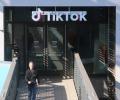
The US Supreme Court has upheld a law requiring TikTok's China-based parent company to divest from the app, paving the way for the popular platform to be banned from the US starting Sunday. The court's decision was unanimous, with the justices citing national security concerns related to TikTok's data collection practices and relationship with a foreign adversary. While existing users may still access the app, new users will be unable to download it and updates will no longer be available. The decision comes as the Biden administration prepares to hand over the reins to the incoming Trump administration, which is expected to review the situation before making a final determination on TikTok's fate.

Biden has been under attack from his opponents and the Republican Party for his immigration policies as hundreds and thousands of illegal immigrants enter the United States every month.

The heightened global uncertainty due to the US "reciprocal tariffs" on India may cause near-term corrections and market turbulence, but the long-term outlook remains constructive, market experts said on Thursday. The US has announced 27 per cent reciprocal tariffs on India, citing high import duties imposed by New Delhi on American goods.
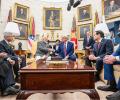
'The US has agreed to negotiate with us a mutually beneficial bilateral trade agreement, which will go for reduction of tariffs on both sides so that our trade can grow.'

Moody's Ratings on Tuesday said India has a lower overall exposure to the US relative to others in the APAC region, although certain sectors such as food, textiles and pharmaceutical products face risks. Moody's said most companies in its rated portfolio are domestic-focused with limited exposure to the US market.

With stricter policies dampening the US/UK dream, Germany, Ireland and New Zealand are emerges as new study abroad destinations for Indian students.
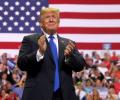
'I love clean air but Russia and China, you look at a map you have all these spots and India and many others are spewing it in. What do you suggest?'
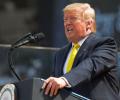
Trump has repeatedly blamed China for the coronavirus pandemic which originated in the central Chinese city of Wuhan in December last year and accused Beijing of suppressing the details of the contagion.

Trump said India and China - the two economic giants from Asia - are no longer developing nations and as such they cannot take benefit from the WTO.

Equity benchmark indices are facing massive corrections, with the NSE Nifty declining over 14 per cent from its lifetime high hit in September last year due to several negative triggers like stretched valuations, foreign fund exodus, disappointing quarterly earnings and rising global trade tensions dragging markets lower. The BSE benchmark Sensex hit its record peak of 85,978.25 on September 27 last year, and the Nifty also reached a lifetime high of 26,277.35 on the same day.

S&P Global Ratings on Tuesday cut India's GDP growth projections to 6.5 per cent for the next fiscal as it expects that economies in the APAC region will feel the strain of rising US tariffs and pushback on globalisation. In its Economic Outlook for Asia-Pacific (APAC), S&P said despite these external strains, it expects domestic demand momentum to remain solid in most emerging-market economies.

Dalal Street investors were a poorer lot on Monday as their wealth eroded sharply by Rs 14 lakh crore following a sharp decline in benchmark indices amid a global market meltdown due to recession fears. The 30-share BSE Sensex tumbled 2,226.79 points or 2.95 per cent to settle at 73,137.90. Intra-day, the benchmark slumped 3,939.68 points or 5.22 per cent to 71,425.01.

All Sensex shares, except for Hindustan Unilever, ended with losses. Tata Steel fell the most by 7.33 per cent followed by Larsen & Toubro which cracked 5.78 per cent. Tata Motors, Kotak Mahindra Bank, Mahindra & Mahindra, Infosys, Axis Bank, ICICI Bank, HCL Technologies and HDFC Bank were the other big laggards. Hindustan Unilever ended marginally higher.
'It's a very tough situation. We're talking to India. We're talking to China. They've got a big problem there'

'If Pakistan's army wants to escalate violence in Kashmir, they have an unlimited supply of jihadis they can train and send. That's not an issue for them.'
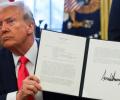
The sweeping tariffs proposed across sectors by US President Donald Trump are scheduled to be imposed starting April 2, with most analysts worried about their impact on companies, and in turn the financial markets. Recently, the US administration signaled that it will impose sectoral tariffs on energy, pharmaceuticals, semiconductors, agriculture, copper, and lumber.
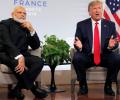
Trump on Wednesday said in a tweet that he was "ready, willing and able to mediate" between the two countries.

'Will this near-war, India's strongest military response so far, buy India another seven years of deterrence?' asks Shekhar Gupta.

'It was inspired by the Hamas attack and was like their attack -- well planned and well executed.'
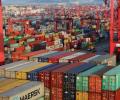
Exporters on Thursday sought a fund of Rs 750 crore for three years to tap USD 25 billion export potential in the US, aiming to seize potential opportunities that may arise as the US President-elect, Donald Trump, has threatened to impose high tariffs on Chinese goods. In its pre-Budget meeting with the finance ministry, Federation of Indian Export Organisations (FIEO) President Ashwani Kumar has also demanded extension of the five per cent Interest Equalisation Scheme (IES).

Global trends, macroeconomic announcements and US tariff developments are expected to drive stock markets in a holiday-shortened week, analysts said. Market participants will also closely track foreign investor activity, geopolitical tensions, and their impact on the US dollar and crude oil prices, they added.

'Inflation is not good for industry. Nor for the economy as a whole.'

'War is not an answer. War is not a solution.' 'Deterrence is a solution. We should have the stick with us with which we can beat Pakistan.'

Investors became richer by nearly Rs 8 lakh crore on Wednesday as benchmark BSE Sensex surged by 740 points amid value buying in utilities and power shares and a strong trend in global markets. The 30-share BSE Sensex surged by 740.30 points or 1.01 per cent to close at 73,730.23.
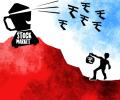
Dalal Street had a roller coaster ride in 2024 from shattering record after record to facing heavy correction off-late but equity markets still rewarded investors with positive returns, driven by a surge in domestic fund flows and a resilient macro landscape. The first half of the year saw robust corporate earnings, a surge in domestic flows, and a resilient macro landscape, driving the Nifty to an all-time high of 26,277.35 in September 2024, according to Motilal Oswal Wealth Management.
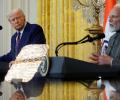
'But I don't think the government is in a great hurry to sign the BTA.'
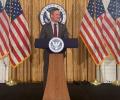
Waltz after being elected as the Co-Chair of India Caucus in January last year had said that India is the world's largest democracy and an important strategic partner for the United States.

The US president's remarks in this regard come days after senior Indian and Chinese military commanders held talks aimed at resolving the months-long standoff along the Line of Actual Control in Ladakh. The two countries agreed to stop sending more troops to their disputed border in the Himalayas.

"When you look at our opponents in this race, you think the Chinese gave Hunter Biden $1.5 billion -- because he was a great businessman, or because they knew the Bidens could be bought, and therefore soft on China," he said.

Jaishankar described as a "reasonable supposition" to expect some improvement in the relations between India and China following the last round of disengagement but hesitated to say that there could be a reset of the ties.

Appearing in a federal courthouse in downtown Washington, DC, Trump entered the not guilty plea before Indian-American judge Magistrate Moxila Upadhyaya.

The move comes after the US-China relationship showed significant growth after Trump's first ever meeting with his Chinese counterpart Xi Jinping.

Global fund managers witnessed one of their largest-ever declines in assets under custody (AUC) during the ongoing correction in the Indian markets, as stocks came under pressure from foreign outflows and the weakening rupee.

Foreign investors were net sellers of domestic debt in October for the first time since the official inclusion of Indian government bonds in the JP Morgan bond indices, with net outflow worth Rs 4,697 crore. This marked the second instance in the current calendar year where foreign portfolio investors (FPIs) were net sellers in a month.

Global funds have pulled out Rs 1.54 trillion from domestic stocks in fiscal 2024 - 25 (FY25), the highest-ever outflow recorded so far, according to the data compiled by Business Standard. The last time the global funds exited Indian shores in droves was back in 2022, when they sold a net Rs 1.41 in the backdrop of Covid-19.

In many must-win battleground states, Indian Americans comprise a substantial and potentially decisive share of the electorate: 190,000 potential voters in Florida, 120,000 in Michigan, 170,000 in Pennsylvania, 150,000 in Georgia, 110,000 in North Carolina, 165,000 in Virginia, and nearly 470,000 in Texas.

The President-elect has already infuriated China by talking over phone with the Taiwanese President, the first by a top American leader since 1979.
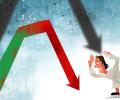
'Market corrections are a natural part of investing, so it's essential to remain focused on long-term financial goals.'
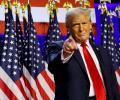
Firodia talked about his plans for the EV-components business, and the components business at large for the group

The Reserve Bank of India (RBI) is expected to cut interest rates for the first time in nearly five years in Governor Sanjay Malhotra's first monetary policy committee (MPC) meeting on Wednesday. The meeting of the six-member MPC, which will culminate on Friday, aims to boost sluggish economic growth, which is seen falling to a four-year low. Malhotra took charge as the 26th RBI governor in December last year.
